A close look at the craft, and what completely changes when your reader grows up
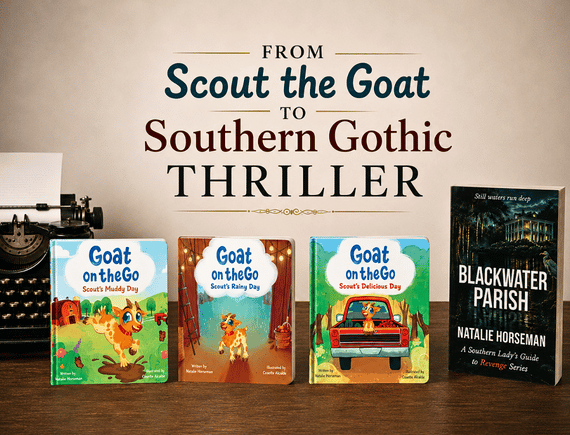
On paper, Goat on the Go and Blackwater Parish have almost nothing in common. One is a few hundred warm words for a preschooler. The other is a dark, layered thriller for adults. Writing both taught me that genre changes the craft far more than people assume, even when the storytelling instincts underneath stay the same.
Word Economy Works in Opposite Directions
A picture book is an exercise in subtraction. Every word has to earn its place because there are so few of them. If I can cut a sentence and keep the meaning, I cut it. The pictures carry half the story, so my words have to leave room for them. Restraint is the whole game.
A thriller asks for a different discipline. There is more room, but that room is dangerous. I can build atmosphere, layer detail, and let dread accumulate. The skill is not in saying less. It is in knowing which details deepen the tension and which ones slow it down. Both forms demand precision. They just aim it in opposite directions.
You Can Finally Sit in Discomfort
In a children’s book, discomfort is brief and always resolved with care. Scout feels real disappointment when the fair is canceled, but I do not leave him there. The whole emotional contract of a picture book is that the child closes it feeling safe.
A thriller makes the opposite promise. When Catherine wakes with blood beneath her nails and a husband insisting her memory cannot be trusted, I am allowed to leave the reader unsettled for a long time. The discomfort is the point. I had to give myself permission to stop rescuing the reader from every hard moment, and that was a real adjustment.
Structure Stretches and Twists
Picture book structure is clean and visible. A beginning, a turn, a satisfying close, often shaped to be read aloud and repeated. Children love the predictability. The structure is a comfort in itself.
A psychological thriller hides its structure on purpose. A slow burn relies on withholding, on misdirection, on letting the reader feel certain and then pulling the floor out. Information is doled out deliberately. What the reader does not know is as carefully built as what they do. That kind of architecture took me much longer to plan.
Trust Looks Different at Every Age
With children, I trust them to receive a clear meaning without me overstating it. I trust a four year old to feel that being different is a gift without lecturing them about it.
With adult readers, I trust them with darkness. I trust them to sit with a character who is being deceived, to suspect what she cannot yet see, and to hold ambiguity without needing it resolved on the next page. The respect is the same. The thing I am trusting them to handle is not.
What Nursing Brought to Both
My nursing career is the bridge between these two kinds of writing. Caring for people taught me to read emotion in small signs, to understand how fear and relief move through a body, and to recognize how often the surface hides the truth. A scrunched goat face and a woman second guessing her own memory come from the same well of observation.
The genre decides how I use that knowledge. The knowledge itself does not change.
Revision Becomes a Different Animal
Revising a picture book means weighing single words and the rhythm of a line read aloud. I will move one word a dozen times until the sentence lands cleanly for a child’s ear. The whole text is short enough to hold in my head at once.
Revising a thriller means tracking tension across hundreds of pages. I have to make sure a clue planted early pays off later, that the reader knows exactly enough at every moment, and that the slow burn never goes cold. I cannot hold all of it in my head, so I rely on maps and timelines and a great deal of rereading. The scale of the work is simply different.
What Stays the Same
For all the differences, one thing held steady. Emotional truth has to be real or nothing works. A child knows when a feeling is fake. So does an adult thriller reader. Whether I am writing a goat or a grieving, fighting woman, the feeling has to be honest first. Everything else is technique built on top of that.
Moving between these forms made me better at both. The picture books sharpened my economy. The thriller deepened my patience. I came away convinced that no kind of writing is beneath another. There is only the right form for the truth you are trying to tell.
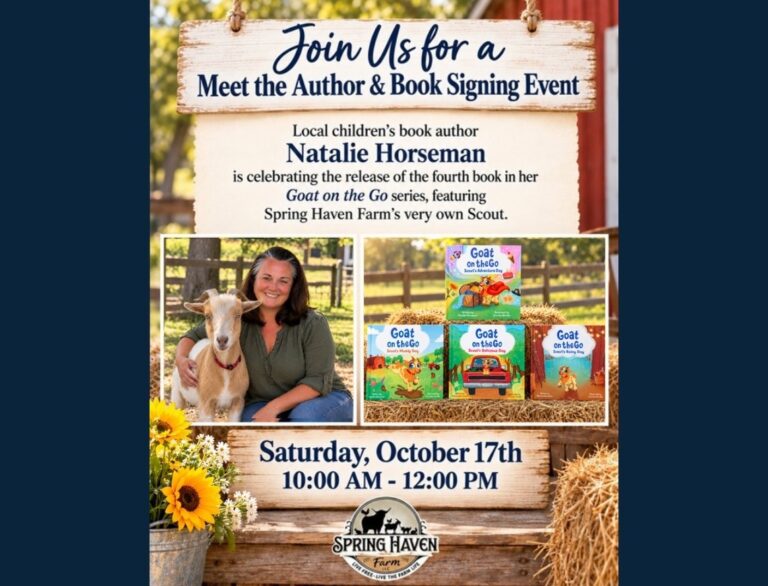 Our Book Launch Party at Spring Haven Farm
 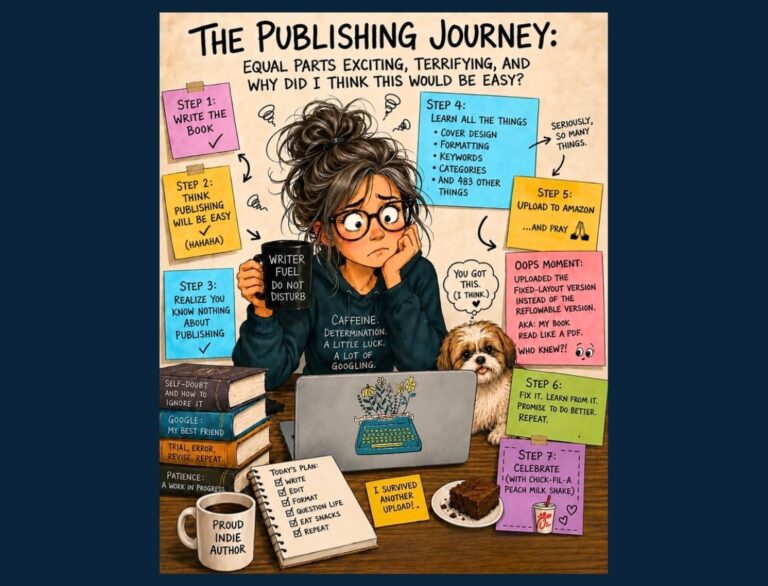 The Publishing Journey, Sticky Notes and All