
February 24, 2026
How to create stories out of thin air and why your kids will love it
A confession from a children's book author: some of the best stories I've ever told didn't come from any book.
They come from observing everyday moments.
You don't need a book to be a storyteller. You just need a beginning, a problem, and a willingness to make it up as you go.
The Oldest Technology in the World
Before there were books, before there was writing, there were people sitting around fires telling stories. Oral storytelling is hardwired into us. It's how humans have passed down knowledge, entertained each other, and made sense of the world for thousands of years.
When you make up a story for your child, you're tapping into something ancient and powerful. You're also giving them something no book can: a story made specifically for them, in that moment, about whatever matters right now.
The Simple Formula
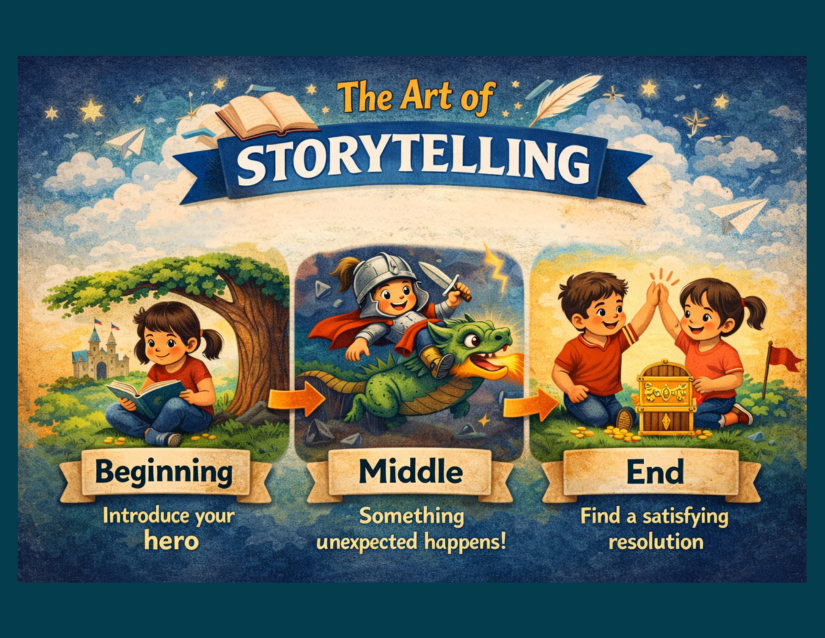
Every story needs three things. A character. A problem. A solution.
That's it. Shakespeare used this formula. Dr. Seuss used this formula. You can use this formula at the dinner table with zero preparation.
"Once there was a sock named Gerald who kept getting lost in the dryer." Character. Problem. Now you just need to figure out where Gerald ends up. Under the couch? In a magical land of lost socks? On an adventure to find his matching partner?
Kids will help you figure it out. They'll shout suggestions. They'll redirect the story in bizarre directions. They'll demand that Gerald meet a dinosaur for no apparent reason. Go with it.
Starring Your Kid
Want to guarantee your child's attention? Make them the main character. "Once there was a kid named [their name] who woke up one morning and discovered they could fly." Instant engagement. They will hang on every word because the story is about them.
You can use this strategically too. A child nervous about starting a new school? "Once there was a kid named [their name] who walked into a new classroom and felt butterflies in their stomach." You can explore the fear, work through it, and arrive at a hopeful ending together.
This isn't therapy. It's just storytelling. But the line between the two is thinner than most people realize.
When You Get Stuck
Every improvised story hits a wall. You'll be mid narrative and have absolutely no idea what happens next. This is normal. Professional writers experience this with every single book.
Here are your escape routes. Ask your audience. "What do you think happened next?" Kids always have ideas, and they love being co-creators. Introduce a new character. Stuck? A talking dog shows up. A friendly cloud appears. Problem solving via new character is a time honored literary tradition. Use "suddenly." This word is magic. "Suddenly, a noise came from the closet." It buys you time and creates suspense. End on a cliffhanger.
"And just as Gerald reached for the door handle... we'll find out what happens tomorrow night." Your child will spend the entire next day thinking about Gerald. You'll spend the entire next day trying to remember what you said.
The Mistakes Are the Best Part
Your story will have plot holes. Characters will change names midway through. The timeline will make no sense. The ending might be "and then everyone had pizza" because you ran out of ideas.
None of that matters.
Children don't care about narrative consistency. They care about the experience of having someone create a story just for them. The fumbles, the laughter when you forget what you said, the collaborative "wait, wasn't the dog named Biscuit?" moments are all part of the magic.
Some of the best laughs our family has had came from stories that went completely off the rails.
Building the Habit
Start small. A one minute story in the car. A quick tale while waiting for food at a restaurant. A tiny narrative about the squirrel outside the window.
You'll get better with practice. Your stories will get longer, more detailed, more creative. You'll develop recurring characters that your family loves. You'll discover your storytelling style.
One family I know has an ongoing saga about a tomato named Frank that has lasted three years. Three years of improvised tomato adventures. The kids request Frank stories by name.
The Connection It Creates
When you tell a child a story you made up, you're giving them something deeply personal. This story doesn't exist in any store. No other child has heard it. It belongs to your family alone.
That exclusivity matters to kids. It tells them they're worth the creative effort. It shows them that stories can come from anyone, including them.
I write books for a living, and I still make up stories for the kids in my life. Sometimes the made up ones land harder than anything I've ever published. Because they're immediate, they're personal, and they're woven from the fabric of that specific moment with that specific child.
Your Turn
Tonight, or tomorrow, or whenever the moment strikes, try it. Start with "Once upon a time" or "One day" or even "So this weird thing happened." See where it goes. Let your child steer. Embrace the chaos.
You're already a storyteller. You tell stories every day, about your commute, about what happened at work, about that weird thing the neighbor's dog did. You just haven't called it storytelling.
Now call it storytelling. And share it with a kid.
Recent & Related Posts: