
February 24, 2026
A love letter to the space that turns reluctant readers into book lovers
Some of the most important learning happens in a corner.
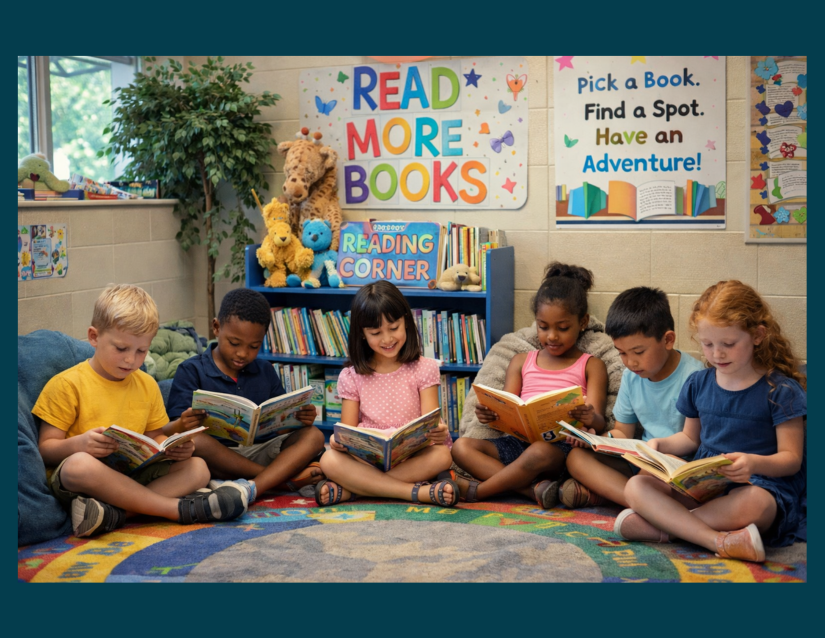
Not the "go stand in the corner" kind. The cozy, cushioned, book filled kind. The reading corner. That small, dedicated space in a classroom where books live, where kids can sink into a story, where the magic of reading gets a physical home.
If you teach and you don't have one yet, let me make the case. And then let me show you how to create one for almost nothing.
Why the Space Matters
Children respond to environments. A classroom with books stacked in a bin sends one message. A classroom with a warm, inviting reading space sends a different one entirely.
The dedicated space says: reading is important here. It's special enough to deserve its own place. It's not homework or obligation. It's something we value enough to make room for.
Research on classroom environments consistently shows that the physical accessibility and visibility of books directly correlates with how much children read independently. When books are easy to see, easy to reach, and surrounded by comfort, kids pick them up more often.
It's that simple and that powerful.
What a Reading Corner Does
Beyond the research, a good reading corner does practical things that benefit every teacher.
It gives early finishers somewhere meaningful to go. Instead of "what do I do now?" the answer becomes "visit the reading corner." That's better for the child and better for classroom management.
It provides a calm down space. Many teachers tell me their reading corner doubles as a regulation zone. A child who needs a moment can sit with a familiar book and reset. Scout's Rainy Day has apparently become a popular choice for this purpose in several classrooms, which makes my heart very full.
It creates book culture. When kids see classmates reading voluntarily, reading becomes aspirational. The cool kid reading in the corner makes reading look appealing to every other kid watching.
It supports choice. A well stocked reading corner offers variety, and variety lets children discover what they actually enjoy rather than only reading what's assigned.
The Zero Budget Version
Let's be realistic. Teachers already spend too much of their own money on their classrooms. A reading corner doesn't have to cost anything.
A corner of the room. Literally just pick a corner. Near a window is ideal, but any quiet corner works.
A blanket or towel on the floor. That's your "reading rug." It defines the space. It signals "this is different from the rest of the classroom."
Books. You already have some. Arrange them face out if possible, because children choose books by covers, not spines. Lean them against the wall. Prop them on the windowsill. Use a cardboard box as a display stand.
A pillow or two. Ask families to donate old ones. Check thrift stores. Use rolled up towels in a pinch.
That's a reading corner. Total cost: potentially zero.
The Upgraded Version
If you have a small budget or generous parent volunteers, you can add floor cushions or bean bags. A small bookshelf, which can often be found for free through community groups. Fairy lights, which are surprisingly affordable and make any space feel magical. A small rug. A lamp.
One teacher I know created her entire reading corner from items donated by families. She sent home a note saying "We're building a classroom reading corner. We'd love any of the following: pillows, small rugs, gently used books, baskets." She had more than she needed within a week.
Book Selection Tips
Your reading corner should have a mix. Picture books, even in upper grades (we've talked about why those matter). Chapter books for more advanced readers. Nonfiction for the fact loving kids. Graphic novels for the visual thinkers. Magazines for the browsers. Joke books for the kids who are still warming up to reading.
Rotate the collection. When you bring in new books, display them prominently. Kids are drawn to novelty. A "new this week" spot generates excitement.
Include books that reflect your students. Books with characters who look like them, live like them, experience things they experience. Representation matters everywhere, but especially in the space designed to make kids feel welcome.
The Unwritten Rules
The best reading corners I've seen operate on a few simple principles. You can come here when your work is done. You treat the books and the space with care. This is a quiet zone. Everyone is welcome.
Some teachers add a sign that says something warm. "All readers welcome here." "This is a no judgment zone." "Find your next adventure." One teacher has a sign that says "You belong in this corner" and kids apparently love it.
For the Teachers Reading This
I know you're stretched thin. I know you're asked to do impossible things with insufficient resources and insufficient time. Creating a reading corner might feel like one more thing on an endless list.
But this one thing has outsized returns. A few pillows and some face out books can shift how your students relate to reading. It's not about creating a Pinterest perfect space. It's about telling kids, through the physical environment, that reading is a gift, not a chore.
My nursing background taught me that environment shapes behavior. The same child behaves differently in a sterile, clinical room versus a warm, welcoming one. Classrooms work the same way.
Create the corner. Fill it with stories. Watch what happens.
Recent & Related Posts: