
December 10, 2025
Why this farm adventure is secretly an emotional toolkit for life
On the surface, Scout's Rainy Day is a story about a goat who can't go to the fair because of a thunderstorm. But like all good children's books, there's so much more happening beneath the surface.
Let's dig into the themes that make this story resonate with kids (and the adults who read to them).
Theme #1: It's Okay to Feel Disappointed
This might be the most important theme in the entire book. When the rain starts and Farmer Ray says "No fair today," we don't rush past Scout's feelings. We sit with them.
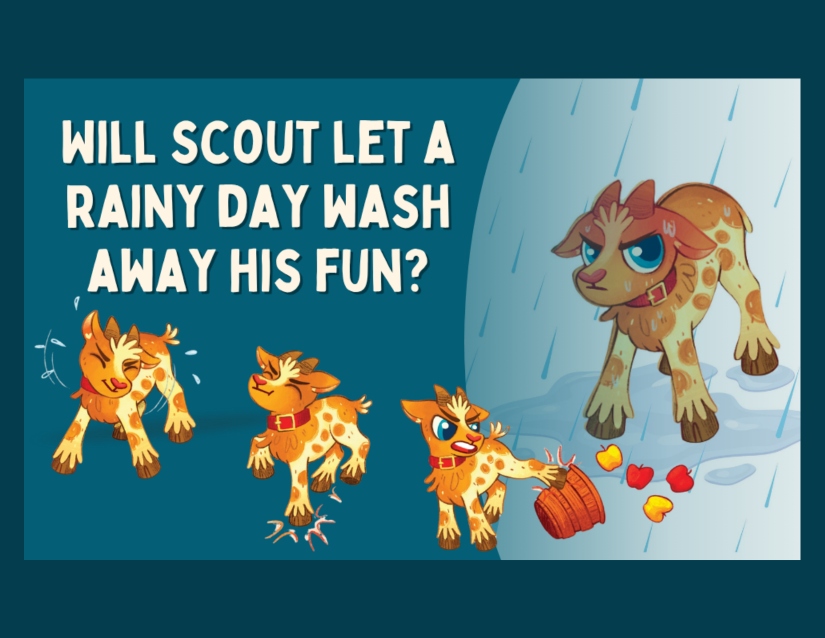
His face scrunches. A grumpy feeling rumbles in his belly. He stomps his hooves. He huffs "This is not fair!" He kicks over a basket of apples.
Why does this matter? Because too often, we accidentally teach kids that negative emotions are problems to be fixed immediately. "Don't be sad!" "Cheer up!" "It's not a big deal!"
But disappointment IS a big deal when you're little. And Scout's Rainy Day validates that. Yes, you can feel all of those big feelings. They're real. They're allowed.
What happens next is what matters.
Theme #2: Friends Show Up in Quiet Ways
After Scout's outburst, he plops down on a hay bale and sighs. Watch what Luna the farm dog does: she settles beside him and lays her head gently on his shoulder.
No advice. No "look on the bright side." No trying to fix it. Just presence.
Working as a nurse taught me that sometimes the most powerful thing we can do for someone in pain is simply be there. Luna models this perfectly. She doesn't try to change Scout's feelings. She just lets him know he's not alone in them.
Kids notice this. They learn that friendship isn't about having answers. It's about showing up.
Theme #3: Joy Can Exist Alongside Disappointment
Here's something subtle but important: the rain doesn't stop. The fair isn't rescheduled. Scout never gets to ride the real Ferris wheel or eat the real cotton candy.
But joy happens anyway.
This is a profound lesson. We often think happiness means getting what we wanted. Scout's Rainy Day shows that happiness can also mean finding something good in what we have.
The barn fair isn't the County Fair. But it's still wonderful. Both things can be true: the original plans would have been great AND what happened instead was also great.
That's not settling. That's resilience.
Theme #4: Creativity Transforms Circumstances
Scout doesn't just join the fun his friends are having. He creates new fun. He stacks milk pails. He invents pumpkin bowling. He organizes a race.
This is the difference between passive acceptance and active engagement. Scout takes his circumstances and shapes them into something exciting.
Children who learn this skill - that they can be creators of their own joy, not just receivers of it - carry that power into adulthood. It's the foundation of problem-solving, entrepreneurship, and emotional resilience.
Theme #5: Community Makes Hard Things Better
Notice that Scout doesn't turn his day around alone. It starts when he hears his friends laughing. It builds when they play games together. It culminates when Luna gives him a prize and everyone celebrates.
The message isn't "pull yourself up by your bootstraps." The message is "we're all in this together."
The animals of Stephens Farm don't ignore the storm or pretend it's not happening. They just refuse to let it steal their joy. And they do that collectively, each contributing something to the barn fair: Hazel's corn cob toss, Odin's wagon rides, Pickles' apple bobbing, and Scout's bowling game.
Everyone brings something. Everyone belongs.
Theme #6: Anticipation and Excitement Aren't Wasted
At the beginning of the story, Scout's anticipation is palpable. He's bouncing on hay bales. His eyes grow wide. A thrill zips through his body.
Some might say that excitement was "wasted" since he never got to the fair. But was it?
That excitement was part of Scout's experience. It was real and valid. And importantly, he transfers that same capacity for excitement to the barn fair. His heart pounds with anticipation at the starting line of the race. He announces his game idea with enthusiasm.
Kids who learn that their ability to feel excitement isn't dependent on specific outcomes are kids who can find joy throughout their lives.
Theme #7: There's Always Something to Look Forward To
The story ends with Pickles hinting at a birthday party. Scout's eyes light up imagining balloons, streamers, and carrot cake with extra frosting.
This is hope in action. Yes, today's plans changed. But tomorrow holds new possibilities. The story doesn't end with "and Scout never got to go to the fair." It ends with excitement about what's next.
This forward-looking orientation is crucial for resilience. The ability to hold onto hope even when current circumstances are disappointing is a skill that serves us throughout life.
Why These Themes Matter Now
In a world where kids face constant change - school schedules shifting, activities getting cancelled, plans evolving - the ability to adapt while maintaining joy is more important than ever.
Scout's Rainy Day doesn't preach these lessons. It shows them. And that's why they stick.
Kids don't need to be told "be flexible" or "look on the bright side." They need to see a character they love navigate disappointment and come out the other side with a smile and a sunflower wreath.
That's the power of story. That's what Scout offers.
For the Adults Reading This
Here's a secret: these themes aren't just for kids. How many of us have had our "County Fair" cancelled? How many of us have stomped our metaphorical hooves and huffed "this is not fair"?
Scout's journey is our journey too. And sometimes we need a little goat to remind us that the best rainy days can turn into the best days ever.
Next post: A complete guide for teachers, librarians, and educators on using Scout's Rainy Day in the classroom...
Recent & Related Posts: