
January 21, 2026
Finding balance without guilt, shame, or pretending you live in 1985
Let's get something out of the way immediately: if your child has watched a screen today, you are not a bad parent.
I know there's pressure to pretend we live in some screen-free utopia where children play with wooden toys and beg for books instead of tablets. But that's not reality for most families. And honestly? That's okay.
The conversation about screens and stories doesn't have to be a war. It can be a balance. And balance looks different for every family.
The False Choice
Somewhere along the way, we started treating screens and books as enemies. Team Screen vs. Team Story Time. Pick a side. Defend your position.
But this is a false choice.
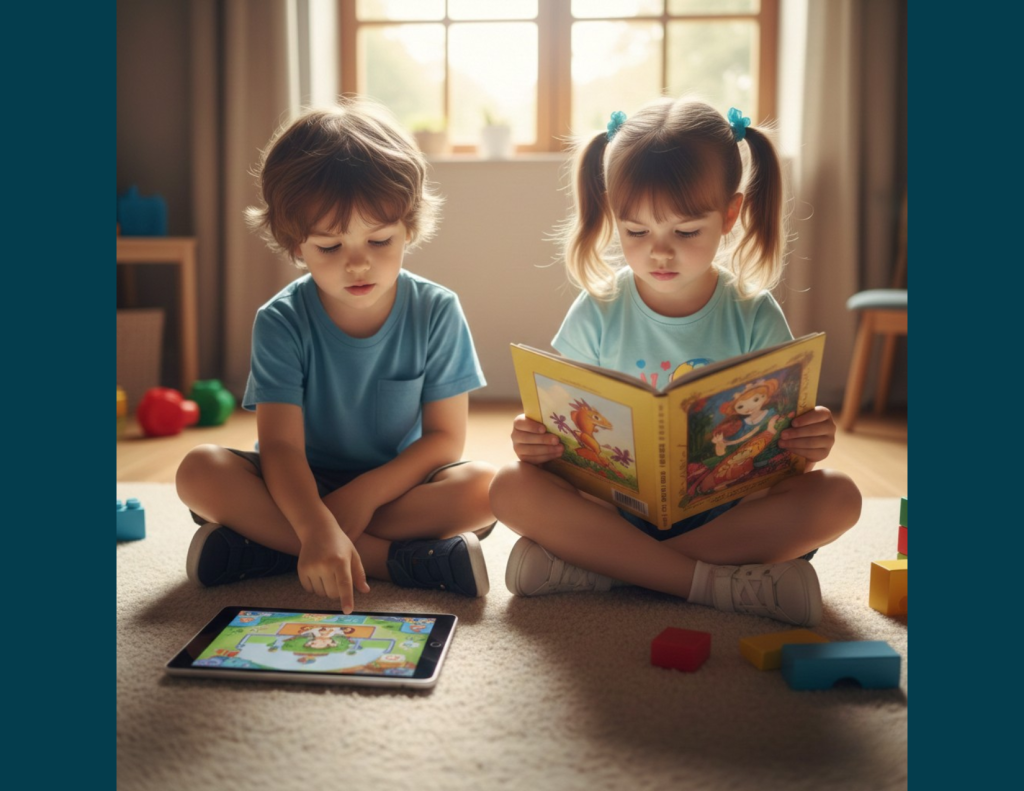
Screens are tools. Books are tools. Both can educate, entertain, and connect. Both can be overused. Both have a place in a child's life.
The goal isn't to eliminate one in favor of the other. The goal is to use both thoughtfully.
What Screens Do Well
Let's be honest about the benefits of screens.
Educational content can introduce concepts in engaging ways. A child fascinated by dinosaurs after watching a nature documentary might devour dinosaur books next. A kid who plays a geography game might suddenly care about maps.
Screens also provide necessary breaks for exhausted parents. If twenty minutes of a show means you can cook dinner without someone climbing the refrigerator, that's a win. Survival counts.
Video calls connect kids with faraway grandparents, cousins, and friends. That's real relationship building, even through a screen.
And audiobooks? Ebooks? Story apps? These are reading. They count. A child listening to a book in the car is still experiencing story, building vocabulary, and developing comprehension.
What Books Do Well
Books offer things screens cannot replicate.
Physical books create no notifications, no autoplay, no algorithm pulling attention elsewhere. When you're reading a book, you're just reading a book. That focused attention is increasingly rare and increasingly valuable.
Reading together creates connection that parallel screen time doesn't. Sitting with a child, sharing a story, pausing to talk about pictures or ask questions. That's bonding that happens in real time, face to face.
Books also let children control the pace. They can linger on a page, flip back, study an illustration. Screens often push forward automatically. Books wait.
And there's something about the physical object. The weight of it. The smell. The ritual of turning pages. These sensory experiences matter, especially for young children still learning how stories work.
Finding Your Family's Balance
Here's the truth: I can't tell you what balance looks like for your family. Only you know your children, your schedule, your needs, your values.
But I can offer some questions that might help.
Is screen time replacing connection time, or creating space for it? If screens mean you never sit together, that's worth examining. If screens give you a break so you can show up more present later, that's different.
Is your child getting a variety of inputs? Some screens, some books, some outdoor play, some creative time, some social interaction. Variety matters more than strict limits on any one thing.
How does your child behave after screens? Some kids transition fine. Others fall apart. Notice patterns and adjust accordingly.
Are books accessible and appealing? If screens are easy to reach and books are stored away, guess which one wins. Make books as available as the tablet.
Practical Ideas That Actually Work
Instead of rules that feel like punishment, try adjustments that feel natural.
Keep books in the car for waiting time instead of defaulting to phones. Not as a rule, just as an option that's physically present.
Try audiobooks during drives. Same entertainment value as videos, but building literacy skills. My books are available in digital format for exactly this reason.
Create a "books first" habit for bedtime. Screens can happen earlier. The last activity before sleep is reading together.
Let screens inspire book choices. Loved that movie about dogs? Here are three books about dogs. Interest transfers when you help it along.
Read alongside your child while they have screen time. You're modeling that reading is what adults do. They notice.
The Guilt Release
Here's your permission slip: you do not have to feel guilty about screens.
Screens are part of modern childhood. They're part of modern adulthood too. We're all figuring this out together in real time.
What matters is that books are also part of your child's life. Not instead of screens. Alongside them.
Both can exist. Both can thrive. And your family can find a rhythm that works without anyone feeling like a failure.
Balance, not battle. That's the goal.
You're doing better than you think.
Recent & Related Posts: