
January 21, 2026
A spotlight on the farm dog who teaches us that presence is the most powerful gift
Every farm needs a dog. And Stephens Farm has the very best one.
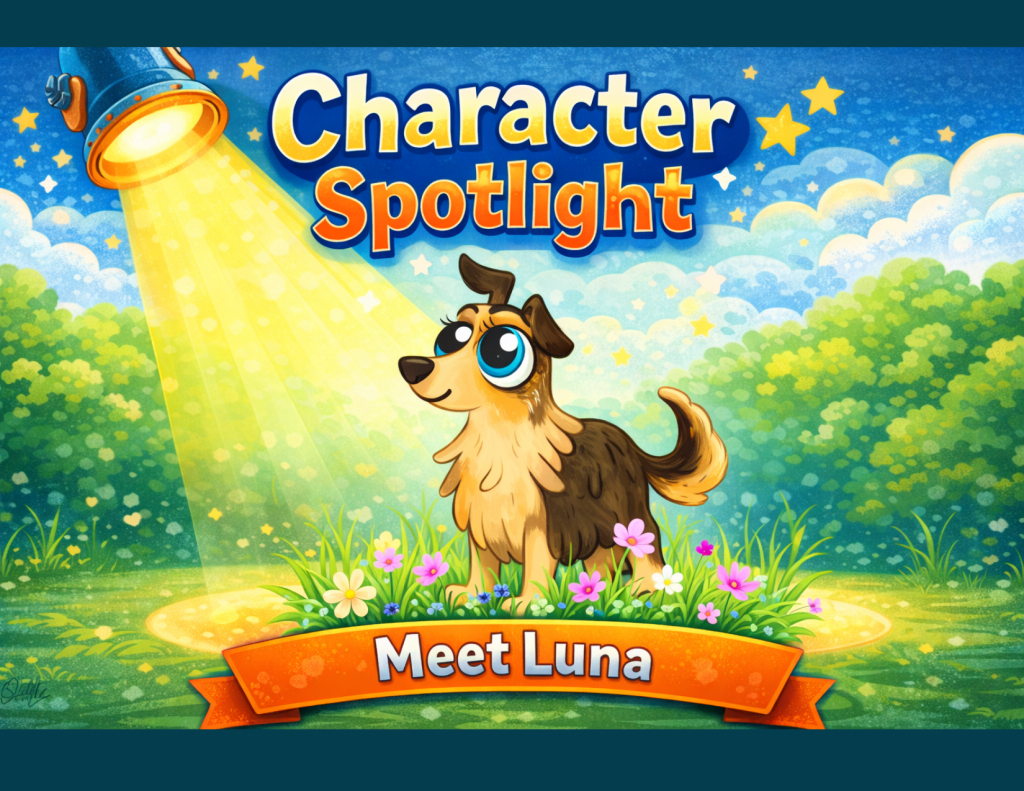
Her name is Luna, and if you've read any of the Goat on the Go books, you've seen her. She's not the loudest character. She doesn't have the biggest adventures. But she might be the most important friend on the entire farm.
Today, I want to tell you about Luna and why she holds such a special place in my heart.
Who Is Luna?
Luna is the farm dog at Stephens Farm. She has soft eyes, a gentle presence, and an uncanny ability to be exactly where she's needed.
In Scout's Delicious Day, she watches over Scout's adventures from a distance, making sure he finds his way home safely. In Scout's Rainy Day, she does something even more powerful: she sits beside Scout when he is experiencing big emotions. In Scout’s Muddy day, Luna follows Scout on his adventure on the farm and make sure his friends recognize him.
Luna doesn't fix things. She doesn't offer advice. She doesn't try to cheer Scout up with jokes or distractions.
She just shows up. And that's everything.
The Moment That Matters
There's a scene in Scout's Rainy Day that gets me every time I read it.
Scout has just learned that the County Fair is cancelled because of the thunderstorm. He's devastated. His face scrunches. He stomps his hooves. He kicks over a basket of apples. Then he plops down on a hay bale and lets out a big sigh.
What happens next?
Luna settles beside him and lays her head gently on his shoulder.
That's it. No words. No advice. Just presence.
And somehow, that presence makes space for everything that comes after. Scout hears his friends laughing. He gets curious. He eventually joins in and creates the barn fair. But none of that would have happened if Luna hadn't first sat with him in his disappointment.
What Luna Teaches Us
Luna models something that's hard for most of us: the art of being with someone in pain without trying to fix it.
When someone we love is hurting, our instinct is to help. We want to solve the problem, offer solutions, point out silver linings. "At least..." "You could try..." "Look on the bright side..."
These responses come from love. But they can accidentally send the message that the person's feelings are problems to be solved rather than experiences to be honored.
Luna doesn't do any of that. She doesn't tell Scout to cheer up. She doesn't remind him that there will be other fairs. She doesn't suggest he go play with his friends.
She just stays. And her staying says: "Your feelings are okay. You're not alone. I'm here."
That's a profound gift.
Teaching Kids to Be a Luna
Children naturally want to help their friends. When a classmate is sad, they might offer toys, suggest games, or try to make them laugh. These are beautiful impulses.
But we can also teach kids the power of simply being present.
"Sometimes when someone is sad, you don't have to say anything. You can just sit with them."
"You don't have to fix it. Just being there helps."
"What do you think Luna was telling Scout by sitting next to him?"
These conversations help children develop a wider toolkit for friendship. Sometimes the situation calls for cheering someone up. Sometimes it calls for sitting quietly together. Learning to read the difference is a skill that serves people for life.
Luna in Our Own Lives
We all have Lunas in our lives if we're lucky. The friend who shows up with coffee and doesn't ask questions. The family member who sits with you during hard seasons without offering unwanted advice. The person who texts "thinking of you" and doesn't expect a response.
These quiet supporters often go unrecognized. They're not dramatic. They don't make grand gestures. They just show up, again and again, with steady presence.
If you have a Luna in your life, tell them what they mean to you. They probably don't realize how much their quiet support matters.
Being Someone's Luna
Here's the invitation: we can all be Lunas for the people we love.
It doesn't require special skills. It doesn't require knowing the right words. It just requires showing up and staying.
Sit with your child when they're disappointed, even if you can't fix it. Be present with a friend who's struggling, even if you don't have solutions. Let people feel their feelings in your company without rushing them toward happiness.
That's Luna energy. And the world needs more of it.
Why I Love Writing Luna
Of all the characters at Stephens Farm, Luna might be the one I most aspire to be like.
She's patient. She's observant. She notices when someone needs her and responds with exactly what they need: her presence.
Scout gets the adventures. Luna holds the space that makes adventures possible.
Both matter. Both are needed. And I hope that kids who read these books see value in both ways of being.
Here's to the Lunas. The quiet ones. The steady ones. The ones who show up and stay.
May we recognize them. May we thank them. May we become them.
Recent & Related Posts: